
Seeds in the Soil: Rachel Gloria Adams, Heather Flor Cron, and verónica a. pérez
When the Los Angeles County Museum of Art pursued an ambitious survey of Black art for the 1976 bicentennial, artist Charles White suggested that the museum turn to curator and artist David Driskell, the chair of the Fisk University Art Department in Nashville, Tennessee. Driskell’s personal journal entries documenting his first phone call with LACMA board members offer a glimpse of the seeds he and LACMA planted from which Two Centuries of Black American Art blossomed. This momentous exhibition was the first comprehensive survey of African American art of its kind.
The journal is filled with notes foreshadowing what would become some of Driskell’s most groundbreaking curatorial work alongside sketches of flowers and plants denoting another labor of love for him—gardening at his home in Maine. Between the pages of his journal, these two core elements of Driskell’s life’s work were once seeds that took time and space to cultivate before they took root. This same process guides Indigo Arts Alliance’s David C. Driskell Fellowship at Black Seed Studio named in his honor. It is through the lens of the seed, as both a catalyst and byproduct of artistic expression, that I return to the work exhibited by Driskell fellows Rachel Gloria Adams, Heather Flor Cron, and verónica a. pérez, who were featured in the 2024 group exhibition Seeds in the SOIL, curated by IAA’s Jordia Benjamin and Ashley Page [Editor’s note: and presented in partnership with SOIL Gallery in Seattle}. This exhibition, and by extension the fellowship, harkens back to Driskell’s phone call, where an idea in its most nascent form evolved into something monumental. These three artists developed their own unique visual language through materials that embody the reverence they hold for their ancestral heritage, creating work that builds and reflects community.
When verónica a. pérez moved to Maine after graduating from Philadelphia’s Moore College of Art and Design in 2014, she was working through the emotional pain from the loss of her father. In the wake of his death, pérez expressed her grief through her work, searching for materials and objects that would embody manifestations of his memory. “I was piecing things together, trying to fit these disparate materials together to help me understand my father’s passing and how it influenced my identity,” she says. Through her work, pérez began unraveling the complicated familial ties of her Puerto Rican and Italian heritage, probing themes of sovereignty, nationality, and colonialism juxtaposed with the sense of otherness she felt while pursuing her MFA. She found herself in an environment that failed to acknowledge the themes in her art. “I think it was upsetting for people to hear about my work, when in actuality I’m using it to engender a conversation about the displacement of people in Puerto Rico and how that land has been colonized,” she says. During this time she practiced woodworking, metalworking, and sugar casting, looking for material that could bear the emotional weight of the complicated histories and stories she longed to share. Doris Salcedo, one of pérez’s artistic influences, uses furniture and articles of clothing as surrogates for individuals facing the atrocities of state sanctioned violence in Colombia. Through symbolic gestures embedded within objects, pérez sought an analogous form of social sculpture, using material that could elicit an emotional connection and a constructive dialogue between the artist and the viewer.
She ultimately found that medium, gifted to her in the form of a large bag of synthetic hair she received from a fellow graduate student. She began braiding it, discovering hair’s capacity to contain the physical, spiritual, and historical essence of her subjects. Through hair, pérez found her voice in work that harmonizes material, medium, and performance by engaging the viewer in deeper reflections on home. She began creating braids with the synthetic hair that she fashioned into sculptural tapestries. These sculptures grew out of “Braiding Circles” hosted by pérez, who brought people together to lovingly plait bundles of hair. As participants engaged in the meditative and somatic practice of combing, sectioning, and lacing hair together, memories and emotions would spring from their fingertips, and they began to share stories with one another. The sacred space created by pérez mimics the sanctity of the beauty salon, a communal space that elicits a sense of vulnerability as much as it engenders safety and security. Using these braids, pérez creates abstracted multimedia works embellished with beads, sequins, rhinestones and other objects that evoke the beguiling, layered subtleties found in the work of Ebony G. Patterson whose haunting forms are shrouded within objects of adornment. Similarly, pérez seduces the eye with the lure of spectacle, concealing a bitter and sometimes sinister reality beneath a veneer of eye-catching delights. In her Summer 2026 show at Ticonic Gallery titled WHAT COULD HAVE BEEN, WHAT IS, WHAT COULD BE, pérez collapsed lament and loss together within amorphous forms that draw the viewer in—one piece, a small sculpted bust of a veiled woman in dark clay embellished with black shells and rhinestones rested on the gallery floor with crystal tears rendered in long strings of white beads that flow from her face as it crouched on the gallery floor. Other works, large, black craterous forms, contained the glistening sparkle of a geode that’s been cracked open. They are alluring pieces that speak to commercial exploitation, natural resource extraction, and cultural erasure in Puerto Rico. Here, pérez teases discomfort to the surface. “You’ve got to sit with it and figure out why it makes you so uncomfortable,” she says.
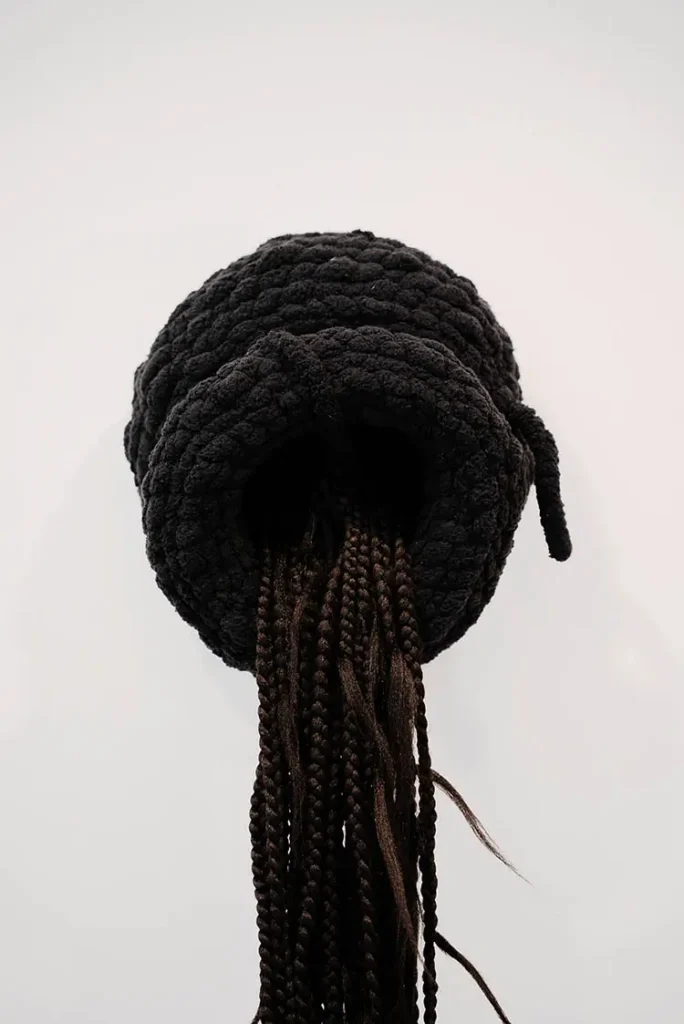
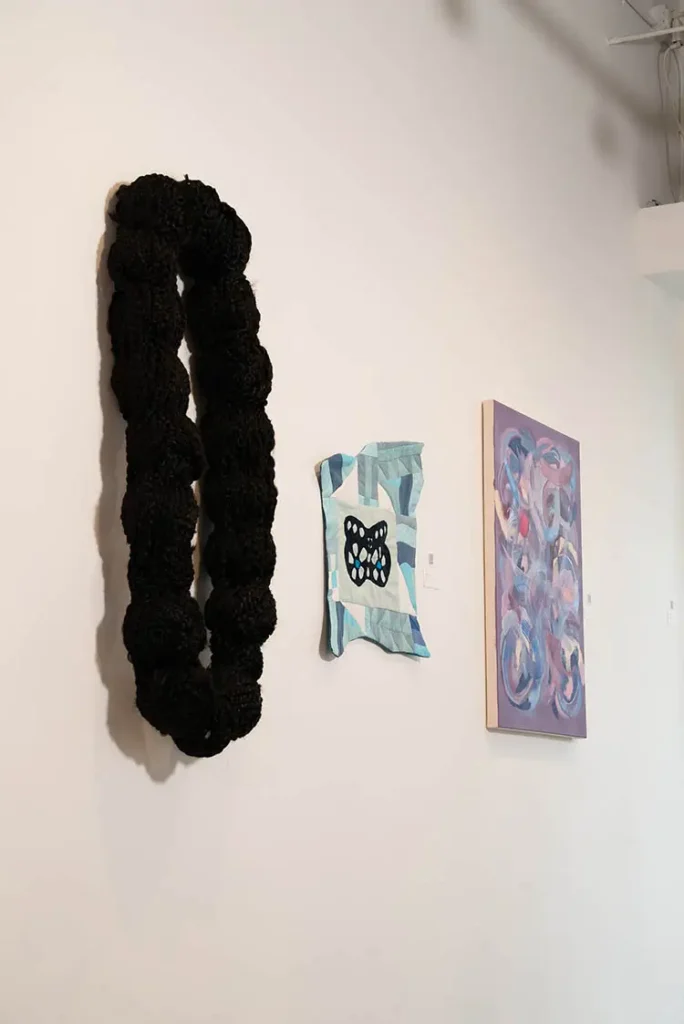
Images from Seeds in the Soil Exhibition
Photos by Josh True
Rachel Gloria Adams celebrates the essence of home and belonging through her colorful, vibrant paintings and textile designs. Her maximalist eye for color combined with a minimalist approach to line reflects the breadth of her influences including traditional quilting, Finnish textiles, African mudcloth prints, and Mexican papel picado banners. Early in her career, Adams’ experience in textile design and printmaking guided her style and layered approach to her work. Over the years her designs build on one another, reflecting an evolution in scale and process. Her recent quilt portraits of cherished family moments playing on the beach, gardening, or relaxing with her children, are quaint slices of life that she embellishes with quilting motifs that conjure the comforts of home. These quilting traditions trace back to the matrilineal lines within her family, particularly her mother, Sharon Chandler, who is an artist, teacher, and the designer behind Marigold in Maine, a line of sustainable clothing created from repurposed quilts.
Adams began incorporating fabrics and textiles into her practice after studying printmaking at the Maine College of Art & Design in the early 2000s. Over the years Adams has explored multiple applications for her designs in creative business ventures that combine painting, textile design, and quilt making. Additionally, residencies and incubation programs, including the Driskell Fellowship, provided Adams with opportunities to take older ideas and concepts and experiment with them in new ways. When reflecting on this interchangeability between styles in her practice, Adams frequently notes, “I quilt what I can’t paint and paint what I can’t quilt”—early paintings become studies for textiles, or sewn handwork studies turn into reimagined paintings or design patterns.
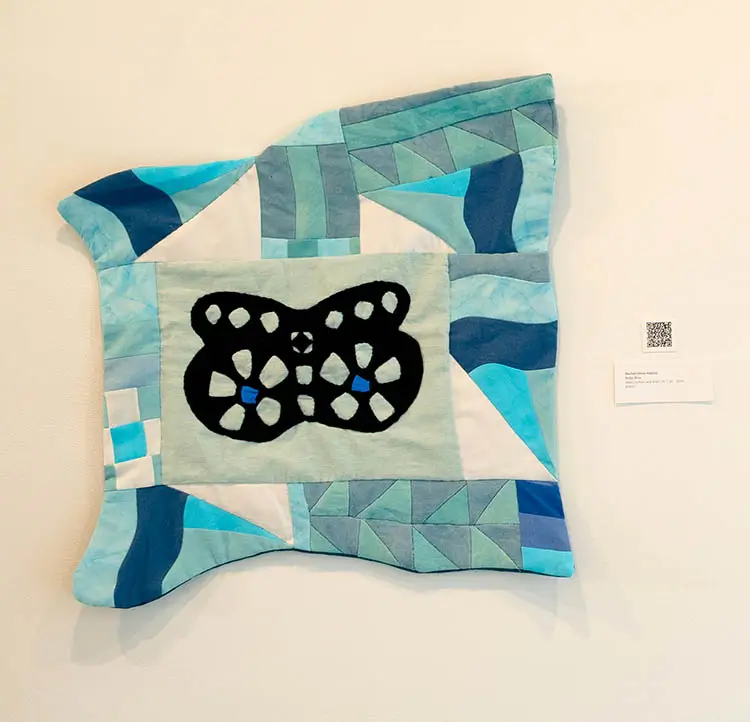
Images from Seeds in the Soil Exhibition
Photos by Josh True
Where this visual language exchange is most recognizable is through the large-scale mural projects in Portland, Maine, she creates in collaboration with her husband and creative partner, muralist Ryan Adams who has been painting murals for over fifteen years. With an established artistic practice, scaling her work into murals was a smooth process for Adams. In February 2021 she created a pair of murals for the Children’s Museum; one blue-hued wall painting featuring graphic shapes and abstract waves provided the backdrop for a museum water exhibit called Go With the Flow, an aqueous Rube Goldberg machine of levers, pulleys, ramps, and clear plastic tubes. Adams’ artistic designs spark curiosity and wonder, and she infuses this energy into all of her other public works. Adams’ work encourages viewers to take delight in sharing joy among one another as an important part of building connection and cultivating community. Her most recent outdoor mural at Thompson’s Point features a colorful, collaged procession of people playing music, dancing, exercising, and enjoying themselves wearing floral patterns and bold geometric designs from her vast archive of graphic prints. Set against a turquoise blue background that’s framed with purple flowers, the playful setting radiates happiness.
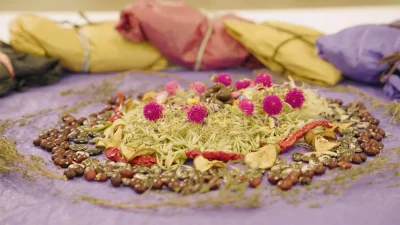
Heather Flor Cron has cultivated a distinctly unique artistic practice that expresses her relationship to home through a practice rooted in land sovereignty and social activism. In her mutual aid work with Presente! Maine, a grassroots rapid-response organization that provides food, legal, and health-related resources for Black, Latine, and Indigenous communities, Cron operates a two-acre farm and plant sanctuary where her self-admitted fascination with seeds influenced her artistic practice. As a Portland based multi-media artist, printmaker, and seed painter, Cron creates works of art made from plant material including flowers, seeds, and beans in a meditative process that mimics the temporal qualities of sand mandalas.
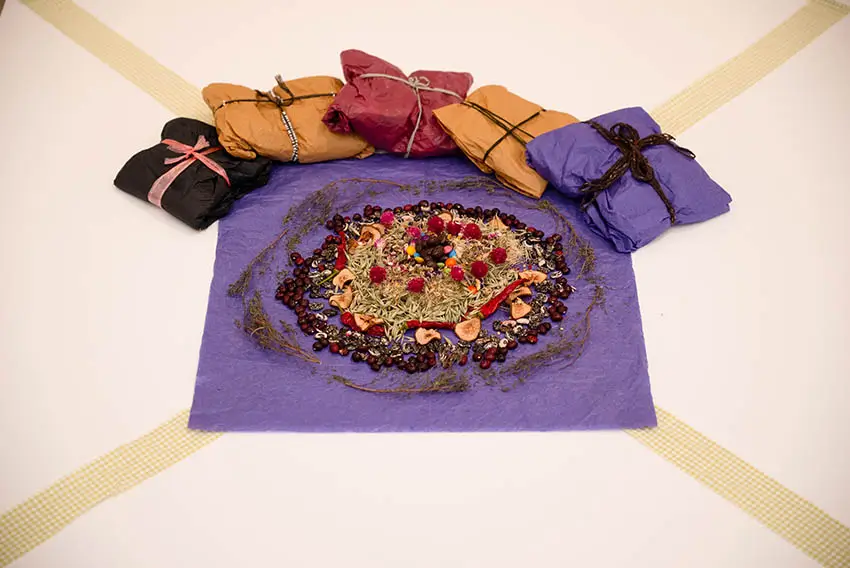
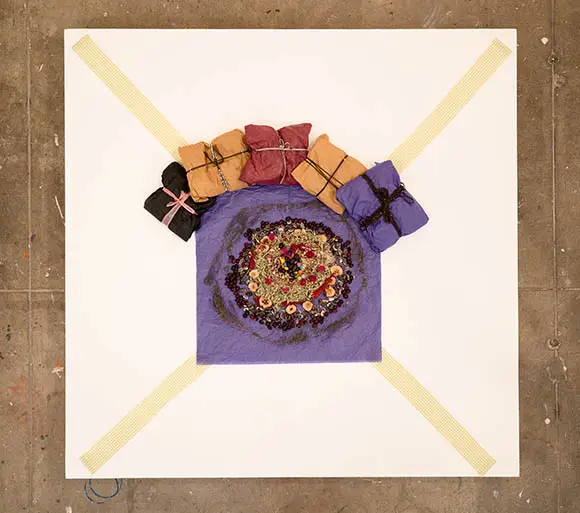
Images from Seeds in the Soil Exhibition
Photos by Josh True
As a child growing up in Maine, Cron was influenced by memories of traveling to Peru and experiencing the vibrant colors and woven textile designs in her mother’s home country. She also loved to draw, which ultimately led her to the Maine College of Art & Design to study printmaking and sculpture. Cron’s matrilineal Peruvian heritage inspires the communal and ceremonial acts of care that undergirds her work. “My mom is a cook, my Abuelita was also a cook; she grew up in the Andes mountains in Peru and was a subsistence farmer. I would hear stories growing up of her farming and her deep reverence for food,” she says. When Cron’s grandmother moved to the states to be closer to family, Cron recalls the moments when food conjured fond memories of home for her. “She would just light up when we went to a farmer’s market,” says Cron. “There weren’t grocery stores where she grew up—either you’re getting produce from your neighbor or your own farms.”
This cooperative spirit shows up in her work. After running a food delivery program for migrant farmworkers impacted by the pandemic, Presente! Maine partnered with Land in Common, a nonprofit community land trust that establishes reciprocal land use agreements on Wabanaki land. Through gardening on the farm, Cron deepened her relationship with the communities that Presente! Maine serves. Cron evokes a spirit of reciprocity within her artwork using material that represents the very essence of life—the seed.
Flor began collecting and cataloguing seeds to document her first year gardening on the farm, using the surplus for her seed paintings. These installations are made with hand-placed seeds and harvested plant material that’s arranged on flat surfaces that are covered with hand dyed fabric. It’s a form of process art; she avoids affixing the seeds with adhesives to the painting surface, opting to present the material as a temporary offering to preserve the seed for other uses. She wraps the remaining plant material in colorful tissue paper that’s tied with twine, yarn, or ribbon, creating ceremonial bundles called “despachos” that are imbued with prayers of intention and gratitude and lit with fire in powerfully reverent burning rituals. Her work is guided by a spirit of reciprocity which is evident in her treatment of plant materials as artistic inspiration and the land as her muse. “It makes me think of lineage, both my own and of this seed and plant; while this is one life cycle, the seed itself is carrying this history back many generations.”
When I interviewed Flor this summer, her community was reeling from the United States Immigration and Customs Enforcement (ICE) killing of Johan Sebastián Durán Guerrero, and as a result Cron has redoubled her efforts into the grassroots work shepherded by Presente! Maine by mobilizing essential resources within the community she serves. This means that her artistic practice looks very different from the work she explored during her Indigo Arts Alliance residency, yet without that opportunity her life’s work would not have evolved into what it is today, a practice that is grounded in connection, both within the community and to the land. “Just having space to hold both is really important to me,” says Cron. Through her work, Cron’s goal is to disentangle the relationship between land and capitalism. “Having a place where people could relate to the land, relearning how to be with this land where it’s not through labor and exploitation.”
Through uncommon materials, thoughtful placemaking, and activism, verónica pérez, Rachel Gloria Adams, and Heather Flor Cron harness the power of connection to create works that celebrate their unique ancestral ties, inspire new cultural practices rooted in communities that continue to grow and blossom.
Photo credit: Hans Rosemond
Colony Little
Colony Little is an arts writer and cultural critic based in Raleigh, North Carolina, whose writing examines the historical and social context behind contemporary art created by Black artists and artists of color. Her work is featured in Art|Basel, ARTnews, BURNAWAY, CARLA, Cultured Magazine, INDYweek, Southern Cultures, and WALTER Magazine.
Edited by Jenna Crowder
Jenna Crowder is a writer and editor. Her writing has appeared in
Art Papers, Boston Art Review, The Brooklyn Rail, BURNAWAY,
Temporary Art Review, and The Rib, among other places.
jennacrowder.com